August 1, 2024
Like many other Irish expats, I've always thought about going back to 'scoil' and doing an Irish (or 'Gaelic' Irish to those of you not from Ireland!) refresher course at some stage... but low and behold our prayers have been answered as Duolingo has released a new course in Irish now!
For those of you unfamiliar with it, Duolingo is an excellent language learning app in the style of a game. It's free and really easy to use. I have my classes use it all the time for 5 minutes at the beginning or end of class and award extra points to those who are top of the leaderboard at the end of the week. As language teachers we are always trying to find ways to get our students actively involved in the language outside the class. With Duolingo it seems I have really managed to achieve this as I can see that almost all my students are using the app on their own outside class in their free time.
Of course, in my opinion at least, it is no substitute for the real live classroom or for immersing yourself in the language by going to where it is spoken. However it is a really excellent complimentary tool if you are currently studying a language or as a way of refreshing language skills you learnt a few years ago, as I've been doing for German and now, for Irish!
My students have become really interested in it and they compete against each other to see who can get to the highest level. It has been a really great way for them to learn new vocabulary and to practice grammar we are doing in class. The great this is that you can easily login with facebook and you can also follow your mates and see their progress.
If any of you have an account please feel free to look me up and follow me:
https://www.duolingo.com/liamprinter
And now it is 't-am' for some Duolingo 'as Gaeilge'!
I can't take all the credit for this one I must admit but I wanted to share as it worked so well. My Department Head and excellent French teaching colleague, Mrs. Sarah Goodman, allowed me to steal her wonderful idea for teaching the house vocabulary so I now want to share with all of my fine readers. The brilliant thing about this project is that the students are more or less teaching themselves and they learn so much more than the mere vocabulary associated with the house; they also learn prepositions of place, the verbs "hay" and "estar", places in the town, expressions of opinion, quantities, sizes, colours and so much more... all in one project.
The project is called "The house of my dreams" and the students have to plan and draw out their dream house on a large poster, labeling all the rooms and pieces of furniture on their minimum two floors. They are encouraged to be as creative as possible. Next they have to write a 'sales pitch' with at least 25 phrases outlining why the buyer should purchase their house. They have to list what amenities are close-by, what is in the neighborhood, where items are located etc and all using very persuasive vocabulary.
Finally on 'Sales Day' they dress up and present their house to their classmates and teachers who are circling the room asking them questions. Teachers from other classes stopped by and some even brought their native Spanish speakers with them to increase the authenticity of the speech yet further. They were not allowed to have any notes or their speech in front of them, they had to go from memory using their house plan as a guide. In the end, after they had all played the role of both buyer and seller, they each received one voting card where they could vote for one house they would buy listing their reasons (in Spanish) as to why they would purchase it. Every vote they received earned them an extra point on the marking scheme.
I circled the room and talked to them all about their houses and used a grading rubric to mark them on their spoken Spanish as well as their written speech which they had to submit. To say the project was a success is an understatement. They excelled, especially the students with a lower language ability. On their 'one minute summary' feedback post-its they said they loved telling others about their house and loved having others come and "inspect" their plans. They also stated how they liked "getting dressed up as a real estate agent" and they said they surprised themselves at how much they could say. They learnt so much in this two week project that I wouldn't hesitate to do it again and their confidence with speaking grew exponentially. Thank you to Mrs. Goodman for such an awesome idea! Let me know if you've done anything similar in the comments below guys!
So after a week of various activities designed to teach and practice the future tense ('will do' etc) such as TPRS, making up stories, worksheets and reading, I needed to come up with a fun way to assess the students learning. The previous week the class had voted to be assessed orally this time. Where do you always hear lots of the future tense in life? A fortune teller of course! The off the cuff plan was hatched!
How was the room arranged?
We arranged the chairs so the fortune tellers were seated around the room by the walls facing two chairs. The two chairs would be filled by pairs of students who were to be two newlyweds desperate to know what the future holds for them. My highly skilled psychic fortune tellers were hand selected by me as I wanted to use those with the best level of Spanish so they had a chance to show off what they know whilst also subconsciously teaching the pair of newlyweds. They were instructed to come up with the wildest, craziest, weirdest futures they possibly could.
Teach skills as well as content
My 'newlyweds' all composed of at least one person who was a 'mega rich billionaire' who had paid over $350,000 (figure the kids came up with!) for 15 minutes with this world renowned fortune teller. At these extortionate rates it was vital the fortune teller gave lots of information and spoke continuously for the 15 minutes. If he or she didn't do this then it was the role of my 'billionaires' to give out and say 'I am paying you a lot of money. Give me more information'. Some of my recently married couples were also in very modern relationships containing two men, two women or in some cases even 3 people. (This is a lovely way to tackle head on those kids who laugh or complain when placed in a 'modern' couple... challenging and questioning openly their stigmas towards homosexuality if they had any).
Any specific language based instructions?
The only specific language instruction was that the future tense "you will" had to be used. In addition the couple were instructed that they must repeat in utter shock every detail they are told. So it sounded like this "aha... yes I see, you will both go to Jamaica next year" to which they had to respond "What?? We will both go to Jamaica next year". I modeled this with a student at the front of the class before the activity and it served to ensure the entire class was laughing, smiling, enjoying class and most importantly... speaking the target language.
The students (all aged 16-18) loved this part with me being involved. In addition it kept the activity going longer and made our eclectic psychics go through a whole new 'future' with the couple and repeat the process all over again. After another 5-7 minutes the happy couples were instructed to leave without paying and say they will never be back again. At this stage all the couples rotated and went to the next fortune teller where they had to tell the new fortune teller what the last one had told them... "he told us we will have 5 children, then he told us we will go to Jamaica etc." = more practice.
Using TPRS circling technique to review
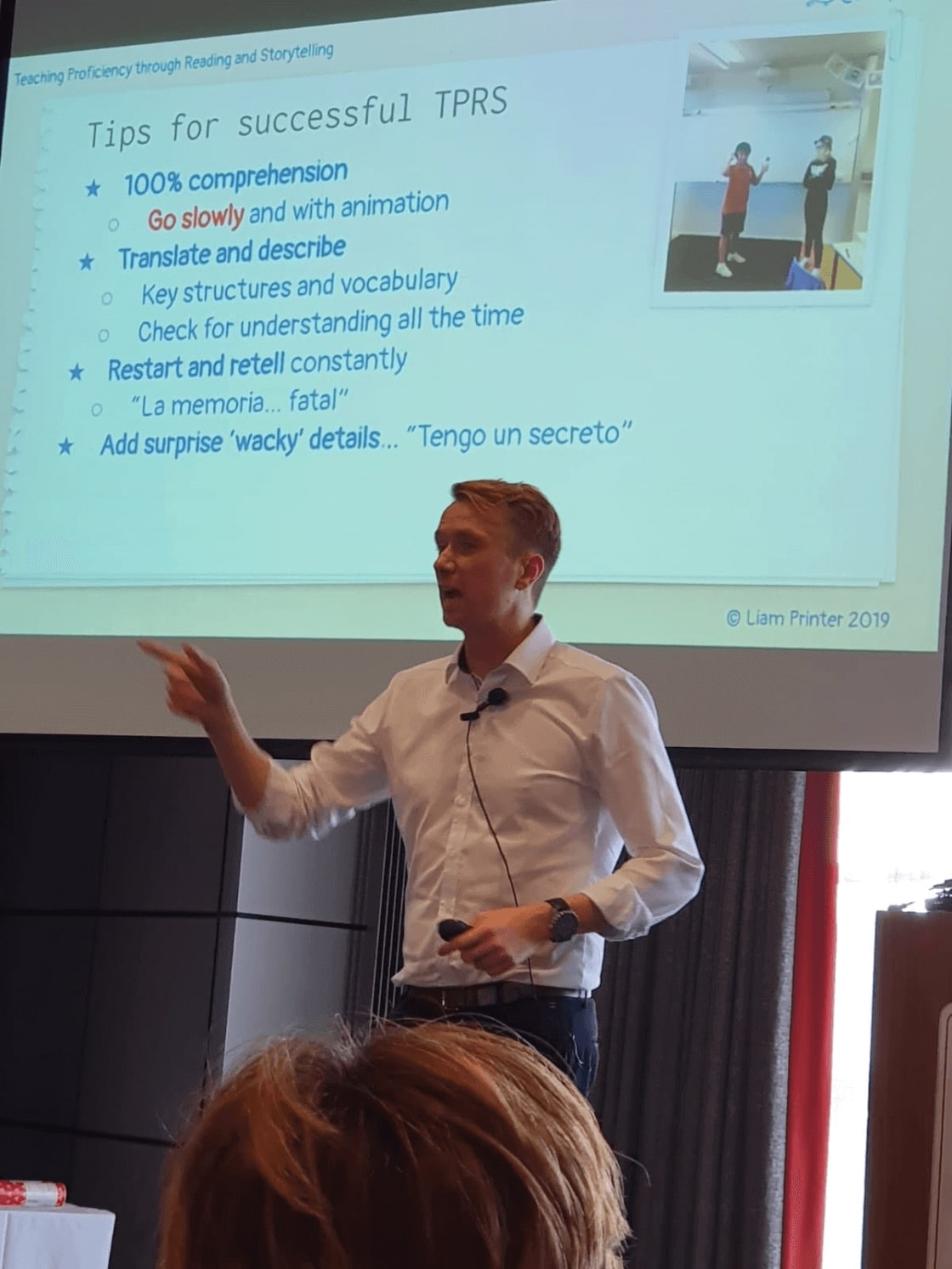
The final piece involved getting the fortune tellers to stand up at the end and say what their clients will do in their future. Here the class is now listening to and practicing the 'they' form. I would interrupt every so often at this stage using the TPRS technique of circling - repeating the phrase with a question that I know is false so the class then had to respond together and correct me: "What? They will go to France"... "No Sir, they will go to Jamaica"... "ahhhh, yes, that is right. They will go to Jamaica". Or asking an 'either/or' question like "Will they go to France or will they go to Jamaica?".... "Ahh, yes, I remember, they will go to Jamaica". Once again here this is all in order to increase the repetitions and the comprehensible input.
How did we review and solidify the learning? First step was an 'Exit Ticket' - students had to tell me one thing that will happen according to the fortune teller in order to be able to leave the room. Second step was homework - write out what the fortune teller told you or write out what you told the clients.
Final thoughts and reflections:
The students absolutely loved this activity and some of them mentioned it directly in their class feedback at the end of the week, stating how much fun it was and how much it helped them to learn. In addition, I also loved my day at work that day. I laughed so much and had such a fun time with them listening to their crazy creative minds being let loose on someone else's future! So much so that I will definitely do it again... see what I did there huh huh? "Will" definitely do it again? Ahhh... never mind! Until next time! Please leave me your comments!
As teachers we always want to provide detailed feedback to the learner that really moves them forward, right? Hattie's famous (2007) study on feedback found that "feedback has more impact on learning that any other general factor". Agreed, right? We all know it is important, but how do we know our feedback is useful and effective, and that it is actually moving the student forward in their learning? And more importantly, how often do we actual engage in giving high quality detailed feedback to each student?
One thing that can be a challenge to us as teachers is that many of us have a different meaning for the word "feedback". In Geoff Petty's (2007) book - "Evidence Based Teaching" he breaks feedback down into three distinctive parts that I have found to be highly effective in my classes:
1. Where am I going? (Goal) - Feed up - Clear and challenging criteria
2. How am I going?(Medal) - Feed back - Informative comments; Process (how) as well as product (what)
3. Where to next? (Mission) - Feed forward - Challenging but achievable clear targets based on last piece of work
Right now of course most teachers reading this are saying "this is all well and good, but when am I supposed to find time to give this kind of detailed feedback to each learner?". Yes, you are right. It can take time to furnish your students with the high quality detailed feedback they need but I think I may have found a way to at least put us on the right track
Feedback Loops & Proformas:
When students submit a piece of writing they must first complete a self assessment sheet (or a 'proforma') answering questions like "I achieved the teachers objective", "I made 3 clear points" or "I made a plan before starting". Immediately there is some accountability on their behalf and they know that if they didn't answer yes to all the questions then they may not achieve the grade they thought it was worth.
The 'teachers objective' is the 1 or maximum 2 specific language focused goals I gave them after their last piece of writing. It can be as specific as "Use the phrase..." or it could be based on format like "include a title". This specific, achievable and realistic goal moves the learner forward. At the end of the proforma I will then give them a new objective for their next piece of writing which they copy on to their next proforma and so the loop continues.
Ok, ok so this all sounds great but what about correcting the actual piece of work? This is the key element. On their proforma they fill in the question "Teacher, please look at and give me feedback on these 2 things in my writing". They then tell me exactly what they want me to look at. So it could be "verb endings" or "adjective agreements" or more general like "the format" or "my conclusion". Now when you correct you have to hold back that red pen and only correct and give feedback on those elements they asked for. We all know how discouraging it is to get a piece of work back covered in red pen but when it is just a few flicks of red here and there, looking at specific, student centered, goals then they can, and will, really improve.
The final part of the process is the "medals and missions" sheet I complete for them. Once again, I ensure I only give them feedback on the items they asked for. Medals are things I like and that they are doing well. Missions are areas to improve on. All specifically related to what they asked me to look for. You can be sure that once you give them this kind of feedback and they do their corrections they will give you something different to look at next time as they feel they have mastered this part, or they might ask you to look at it again if it wasn't very good the last time. The key in all this is that the student is negotiating the feedback and correction process with you. They feel like they are receiving the guidance they need and you have less corrections to do! Everyone is a winner!
Students across all my Spanish classes got involved in some super fun speed dating on their very first day of classes this year... even the complete beginners! It is such a great activity to help them get to know each other, practice speaking and build their confidence.
With my slightly more advanced classes (those with 1 or 2 years of Spanish) I got the students to write 5 questions in pairs on a mini whiteboard. The questions could be anything really but they had to have at least 1 question in past tense and 1 question in future tense. Once they were finished they practiced a little with each other. Then I set them up so they were all facing someone from a different group. The whiteboards stayed on one side of the desks and the students moved around place to place after exactly 1 minute when an alarm would go off. This meant they were reading and using other people's questions too. It worked incredibly well and the students loved moving around the room and chatting to each other.
Some of their hand-writing leaves a lot to be desires so the activity also served nicely in showing them that if they don't write clearly they can't receive the marks they deserve as the examiner might not be able to read it!
With my beginner class the questions were scaffolded for them on the board with the first word of the answer to help them. It still seemed to work well for them even though they were asking the same questions at each spot but I didn't do as many rotations. Definitely a great activity I will be using again to drill certain structures.